

Ch. 2 – No. 4: People Like You
Strange phenomena befall a young Clove.
Ever since some time in early adolescence, Clove had experienced some very strange things. First, she’d begun to see long threadlike fibers floating through the air. Lazily wafting here and there, the fibers wiggled and twisted, producing a myriad of sounds and resonating with some extra sense in Clove for which she had no word. The fibers were always attracted to Clove, like fish to a lure, and without any effort she essentially absorbed them when they touched her skin, imparting a subtle zapping sensation which was jarring though not unpleasant. The fibers did not gravitate toward anyone else around her; never her mother or father, never her aunt or uncle with whom they lived and traveled, nor their two children with whom Clove spent much of her time.
Suspended in the air like fish in water, pushed here and there by natural air currents though seeming to follow a general course, their trajectory was more calculated and their velocity subtly increased as they approached Clove, like a leaf in the current of a whirlpool and she was the eye of the vortex.
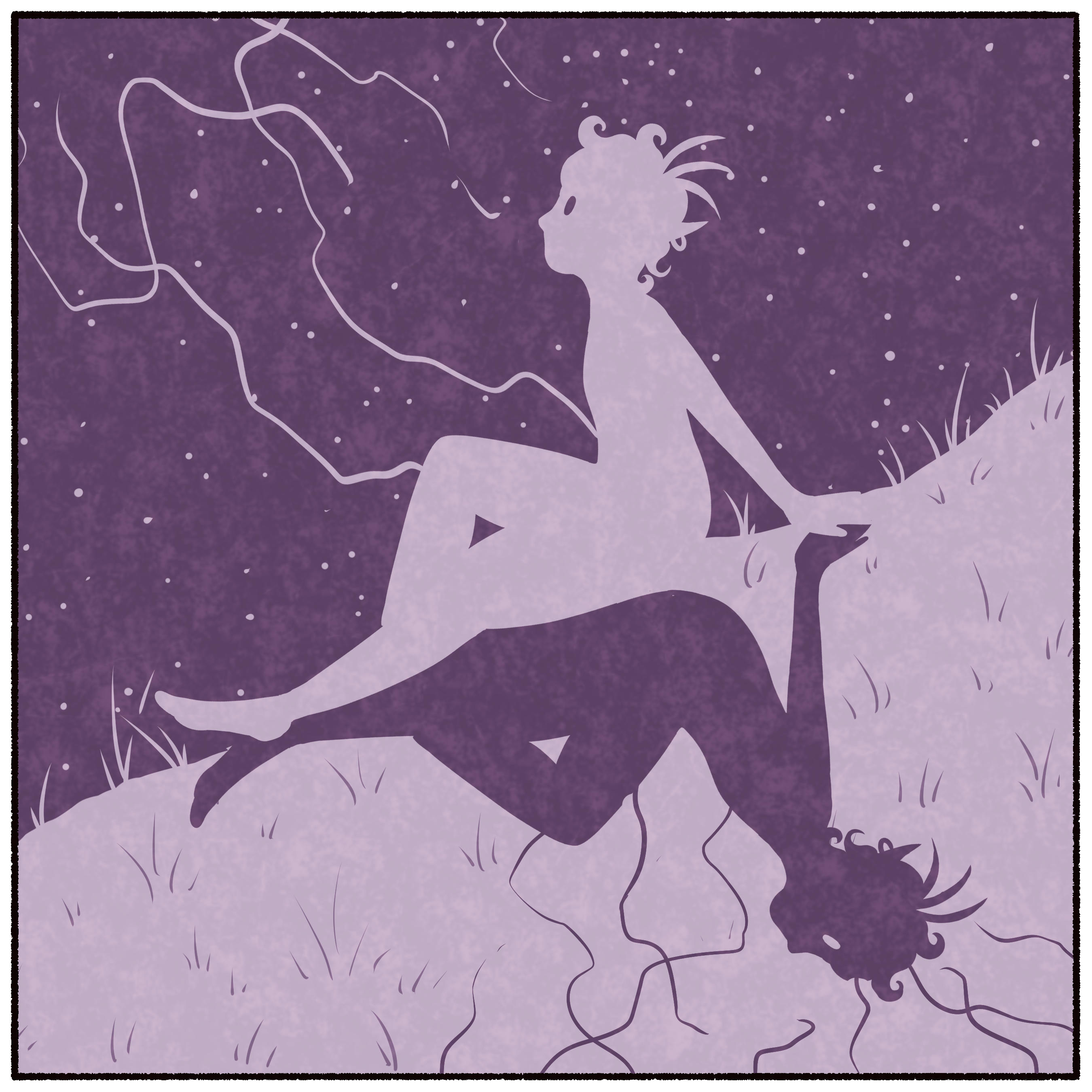
There were always more fibers in crowded areas, almost always pulled toward her, though sometimes they would gravitate toward someone else and vanish into their skin. Even more rarely, a location may have two or three other people to whom the fibers were attracted, and these rare individuals always seemed familiar to Clove despite being complete strangers. Their eyes would meet across a market square, and it was like she was catching a glimpse of her own distorted reflection in a pool of water. They sometimes offered her a fleeting, knowing expression, or even a subtle nod.
A short while after Clove began seeing the fibers, another strange development unfolded, this time in the form of an inexplicable, active impulse rather than a passive sensory experience. The first time it happened, Clove and her family had returned to their camp after a long, unremarkable day working at a market. Dusk fell as the adults chattered somewhere, drinking and cooking, while Clove’s cousins were sprawled on a straw mat nearby, the eldest guiding their brother in sounding out words from a picture book. Clove sat on a stone, sleepily transfixed by the flicker of a lantern flame as she absentmindedly pushed chopped vegetables around a pan atop a modest fire. Suddenly, something in her mind reached out to the lantern flame, snuffing it out. Sitting up, alert now, Clove stared at the dark wick, a little ribbon of smoke rising from it. With another reach of her mind, a new flame sprouted up. She repeated this a few more times, then looked around to see her family still going about their rhythms, unaware. Sparse little fibers were emitted from her skin as she did this.
This epiphany gradually gave way to others: with deeper concentration, she could create a ball of fire in her cupped palm; spring up little flames at her fingertips like a candelabra; light fires without the use of any implements.
Eventually, Clove mentioned these surreal experiences to her mother and father, who dismissed them as being the product of an active imagination, or otherwise simply a child’s vie for attention.
“No, no, I can prove it!” she insisted, holding out her hand while small flames bloomed at her fingertips. Her parents locked eyes with one another in a fleeting and silent exchange, and her mother gently took her hand, smothering the flames with her calloused fingers.
“Do not speak of this to anyone else,” she told Clove.
“Aye,” her father nodded stoically. “And don’t do nothin’ like that,” he gestured to her hand. “I mean it.”
“Why?” Clove inquired, slipping her hand out from her mother’s.
Sighing, her father gazed into the distance. “I dunno much,” he said, propping his hands on his hips, furrowing his brow, and meeting Clove’s gaze, “but I do know that the world can be a hard ‘n dangerous place for people like you. So…just try ‘n’ blend in, okay?” He patted her on the shoulder, and that was the end of it.
Such was Clove’s sense of normalcy. She had yet to learn of any wider narrative surrounding her peculiarities, unable to find even a scrap of knowledge which explained or identified this phenomena. Did anyone else share these qualities?
One other person knew of these experiences. Clove’s cousin Terris was only a year younger than her, and as the two grew up side by side, eventually navigating the perplexing world of adolescence together, they were one another’s closest friends.
“Hmmm…even if it’s something heritable, we wouldn’t have any way of tracing it very far,” Terris postulated the first time Clove confided in them, and she could sense Terris’ excitement at the prospect of a mystery to be solved. Her cousin was right, though. Both of Clove’s parents had been foundlings, raised by adoptive caregivers, and although Clove’s and Terris’ respective mothers were raised as sisters, they did not share a bloodline. This was all a delicious riddle for Terris, and while these peculiarities inspired Clove to turn inward with a preference for solitude, Terris regarded them with a burning curiosity, stoking a fervent interest in unraveling the mysteries of all things strange and unexplainable.

Leave a Reply